The quick-start rules get your first tiles on the table. This reference covers what happens between hands, which settings apply to a new game and how online matches and tournaments keep moving.
Dealing and opening a hand
DoubleSix uses 28 unique double-six tiles, from 0–0 to 6–6. Private tables seat two, three or four players with individual scores. Each active seat receives seven tiles. With two players, 14 remain undealt; with three, seven remain; with four, none remain. In Draw and All Fives, undealt tiles form the boneyard. In Block, they stay out of play.
The highest dealt double must open the first hand. With no dealt double, the highest pip total opens; ties go to the larger endpoint, then seat one. By default, the previous hand’s winner opens the next hand with any tile. Alternating starters can be chosen in Settings. After a tied hand, opening privilege moves to the next active seat.
Which settings apply to your game?
Choose Draw, Block or All Fives when creating a Bix match, Quick match or private table. Quick matching pairs players choosing the same variant. A joining player inherits the table’s rules. The variant stays the same between hands, and each practice variant has its own save on your device.
Settings apply when you create a new game. You can choose a points target and an opening rule. Classic Draw keeps drawing until a match is available or the pile is exhausted. Single Draw gives one tile; an unsuccessful draw yields the turn. Block never draws, while All Fives always uses draw-until-playable.
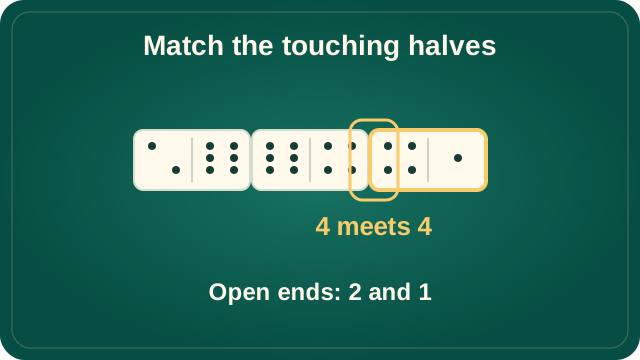
On your turn, drag freely across the board and release near a legal endpoint. Or select a tile and tap the matching end. The tile rotates to fit. Board pinch and pan let you inspect a growing chain; Reframe fits it back into view. Page zoom remains separate from board movement.
Bix difficulty and fair play
Bix plays all three variants. Beginner covers levels one to three, Intermediate four to six and Advanced seven to nine. Beginner is available free online; higher online levels require Club access. Offline practice makes every level available.
The move picker receives only Bix’s own hand, the public chain and legal moves. It receives no opponent tiles or draw order. All Fives scoring is calculated from that public board. You can adjust thinking pace, tile animation, tile size and sound without changing the matching rules.
Points matches and hand series
Ordinary matches use a points target, normally 100. Scores carry between hands. In All Fives, a scoring play can reach the target before the hand is empty. Tournament games continue to use Draw and can instead use a best-of series of one to five hands.
In a series, most hand wins decides the match, with an early finish once a winning majority is reached. Tied blocked hands do not count as wins. An even-length series tied on hand wins uses total points; if those are equal, an extra deciding hand resolves it.
Winner advances or everyone plays everyone
A winner-advances tournament uses a single-elimination bracket. Entrants are shuffled by a server-generated seed, and any byes go to that shuffled order. A bye advances a player without adding a played match or win to their statistics. Both players check in before their match starts, and winners progress automatically.
Round-robin pairs every entrant with every other entrant once. New rounds open after the current round is complete. An odd number of entrants gives one player a rest round, which does not count as a win. Standings rank by match wins, head-to-head wins among tied players, hand difference, then point difference. Exact ties use the recorded seeded order.
Free organisers can host up to ten players; Club supports up to 20, with larger corporate options available. After a tournament, every participant must opt in before a rematch is created. Current membership details are on the pricing page.
When a player disconnects
Online moves are saved to the database. Reopening the same game link restores the table. Human turns have a three-minute playing allowance plus the table’s reconnection grace period, normally two minutes. The displayed deadline includes that grace. Solo Bix matches have no timeout.
When the deadline expires, the current player forfeits. At a private table with three or four seats, a resignation or timeout removes that player from further play and scoring. Remaining players continue, and the final active player wins. A player who has left can still watch.
Tournament check-in closes after five minutes. If only one player is ready, that player advances by forfeit. If neither is ready, the tournament is cancelled rather than assigning an invented result. Table opening and the scheduled recovery job enforce expired deadlines.
Watching a tournament table
Choose Watch match from the bracket or standings. Spectators see the chain, scores, tile counts and whose turn it is, with updates every three seconds. Both hands and the boneyard contents stay hidden. Watching is read-only, and you can change tables as matches progress.
Public tournaments allow guest spectators. Private tournaments limit spectators to the organiser and participants. Eliminated entrants remain part of their tournament group and can keep following the remaining matches.