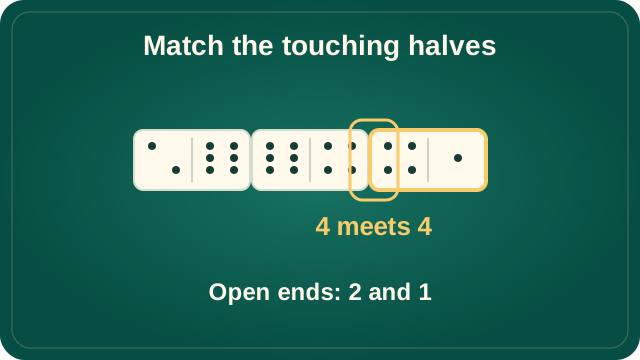
Draw is the familiar starting point: match one of the two open ends, draw when you have no match, and try to empty your hand before your opponent. The numbers on the tiles are pips. A blank counts as zero and matches another blank.
Your first hand, step by step
- Choose Draw when creating a Bix game, a private table or a quick match. Each player receives seven tiles from the 28-tile double-six set. Two players leave 14 tiles in the boneyard; three leave seven; four use the whole set.
- The highest double in the dealt hands opens the first hand. If nobody has a double, the highest pip total opens. The game highlights your legal opening tile when hints are on. A 6–6 in the boneyard does not count as a dealt double.
- On your turn, drag a tile towards a matching end. You can move it freely over the table; it only commits near a legal endpoint when you release. Alternatively, select a tile and tap the matching endpoint. The game turns the tile to fit.
- If neither half of any tile in your hand matches an open end, draw from the boneyard. Under the default Classic Draw rule, continue until you find a playable tile or exhaust the pile. Drawing a match keeps your turn so you can play it.
- If you still cannot play and the boneyard is empty, choose Pass turn. A hand ends when a player plays their last tile, or every active player passes consecutively. The previous hand’s winner opens the next hand by default.
How scoring works
Going out: the player who empties their hand scores the total pips left in the other active players’ hands. Blanks add zero. Scores carry across freshly shuffled hands until someone reaches the target, normally 100.
Blocked hand: the unique player with the fewest remaining pips wins. They score the sum of each other active player’s pip total minus their own. If the lowest total is tied, nobody receives points and another hand begins.
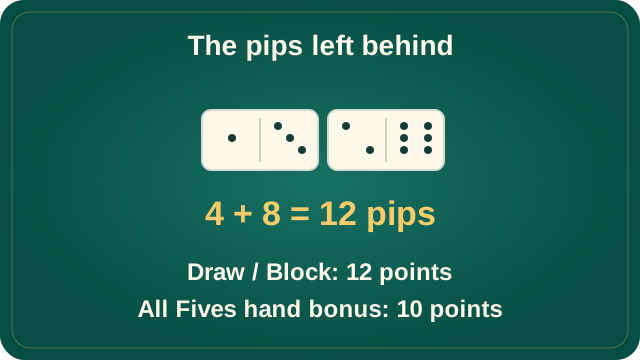
A worked example. You play your last tile. Your opponent has 1–3 and 2–6: four pips plus eight pips gives you 12 points. If instead the hand blocks with you holding five pips and your opponent holding 12, you score seven points.
Three ways to improve your next game
- Keep a number you can match on your next turn; playing your highest tile is not always the best move.
- Doubles can be harder to shed because they only match one number. Look for a safe opportunity to play them.
- Watch passes and draws for clues, but remember that hidden tiles stay hidden. Bix uses only its own hand and the public board.
Try Draw Dominoes now
Start an offline game with Bix to practise at your own pace. For human opponents, select this game in Quick match or create a private table and share the invitation. Each table keeps its chosen rules between hands.