A legal move solves this turn. A good move gives you something useful to do on the next one. In Draw Dominoes, the easiest way to improve is to look at the hand you will have left after playing, rather than at the tile you are about to lose.
Start with both possible boards
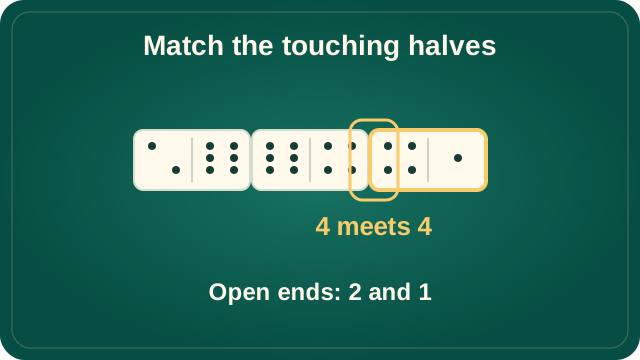
Before committing a tile, check both open ends. A tile that matches two ends can produce two very different positions. There is no need to calculate an entire hand: picture the new numbers, then count how many of your remaining tiles could match them.
Suppose the ends are one and six. Your hand includes 1–6, 4–6, 1–2 and 0–1. Playing 1–6 on the six end leaves one at both ends, which suits your two other tiles containing one. Playing 4–6 leaves one and four. The first move keeps more immediate options for this particular hand, although your opponent can still change the position before you play again.
This is a comparison, not a guarantee. Keeping both ends the same can also leave you vulnerable once that number runs out. Use the pattern in your actual hand, rather than a rule that the ends should always match.
Give awkward tiles a route out
A double matches only one number. A mixed tile has two potential ways to join a chain. That makes a double worth noticing early, especially if the number is disappearing from the public board.
When the number on your double is available, compare the cost of playing it now with the benefit of another move. Removing a difficult tile can be worth more than immediately discarding the most pips. Do not force a double simply because it is a double: if it leaves no useful follow-up, a mixed tile may still be stronger.
Read a draw as information, not certainty
Under Classic Draw, a player draws only when nothing in their hand matches either open end. A draw therefore tells you something about the hand they held at that moment. It does not tell you which tiles they picked up or what they will be able to play later.
After a new tile lands, reassess the visible board. Do not continue acting on an old assumption once your opponent has drawn several tiles. Draw Dominoes rewards flexibility because hands can change substantially between turns.
Watch pips as well as tile count
Two large tiles can be more expensive to hold than three small ones. If you think the hand may block, reducing your pip total protects you in the final comparison. If your opponent is close to going out, a heavy tile left in your hand can become points for them.
During your next practice game, pause before every move and ask yourself three things: what numbers will remain open, what can I play afterwards, and how many pips will I still hold? Change only one habit at a time. Reviewing a single awkward hand is more useful than rushing through ten games without noticing your choices.