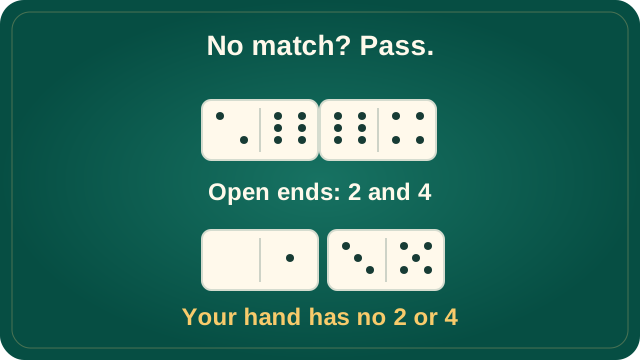
In Block, a pass is public information. No tile is drawn afterwards, so the player who passed keeps the same hand until their next play. You can use that information without knowing a single hidden tile.
Remember the numbers, not just the player
If the ends are two and four when a player passes, they have no tile containing either number. That fact remains useful while their hand is unchanged. If you later get a choice between leaving a two or a five, a two may keep that player under pressure.
Write the observation in your head as “could not match two or four”, not “has a bad hand”. The second statement is a guess. The first follows directly from a legal pass. Another player may change an endpoint and give the person who passed a route back into play.
Control a number you can keep using
Several tiles sharing one number can form the backbone of a strong hand. Try to preserve a route for that number rather than using all of its connecting tiles early. The important question is whether your remaining tiles still reach the numbers on the table.
There are seven distinct tiles containing each number in a double-six set. A double is one tile even though the number appears on both halves. As those tiles become visible, you can get a better sense of how much of that number remains unplayed. With two or three players, remember that undealt tiles are out of play: an unseen tile is not necessarily in an opponent’s hand.
Only welcome a block when the pips suit you
Blocking the board is not automatically a win. The player with the fewest remaining pips wins a blocked hand; tied lowest totals award nobody a bonus. Count your own pips before trying to close a position down.
At a three-player table, a block requires three consecutive passes from active players. If one of them plays, the pass count resets. A move that stops your next opponent can still leave the third player with several options. Think around the whole table, not just across it.
Practise one observation per hand
Begin with a simple exercise against Bix: remember the two ends on the first pass of each hand. On your next turn, see whether either number gives you a useful move. You are training your attention, not trying to memorise all 28 tiles at once.
After the hand ends and the remaining tiles are revealed, compare what you inferred with what was actually held. A correct observation can still lead to a loss because the rest of the hand was unfavourable. Judge the quality of the decision separately from the final score.
Once this feels natural, add your remaining pip total to the routine. Pass information tells you where an opponent cannot play. Your own pip count tells you whether stopping the hand there would be worth it.