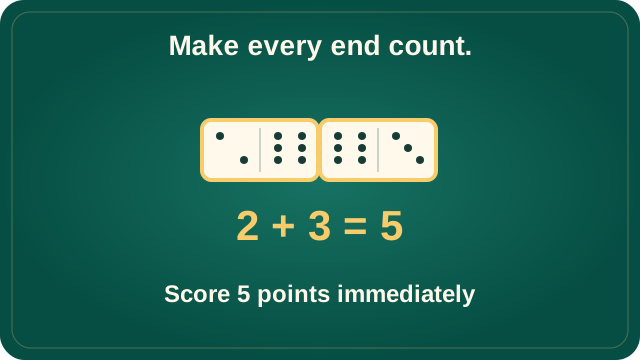
All Fives adds a second question to every turn. Alongside “can I play this?”, ask “what will the ends total afterwards?” Once that calculation becomes comfortable, you can start balancing the points available now against the hand you leave yourself.
Compare the same tile on both ends
When a tile fits either end, do both sums before letting go. On a board with ends two and three, a 2–3 can join the two to leave three and three, scoring nothing. It can instead join the three to leave two and two, also scoring nothing. A tile matching both ends is a choice, not an automatic score.
Now suppose the ends are two and six and you hold 3–6. Playing on six leaves two and three: five points. The game adds those points immediately. You do not count the matching sixes in the middle, and you do not add the total pips on every tile in the chain.
Recount whenever an end double appears
An exposed double counts both halves. A terminal 6–6 contributes 12; with a three at the opposite end, the score is 15. Once another tile covers that double, the double is internal and no longer contributes to the exposed total.
That can make a move surprisingly valuable or unexpectedly scoreless. Slow down for one extra calculation whenever you play a double or cover one. On DoubleSix there are no spinner branches, so you only need to track the two ends.
Points now have a cost as well as a benefit
A scoring move is useful, but it may remove the only tile connecting your hand to a promising number. Compare it with a non-scoring move that leaves several playable options. Neither choice is always correct: the target score, your remaining pips and your opponent’s tile count change the trade-off.
If a scoring play reaches the match target, make it: this ruleset ends the match immediately. Earlier in a match, a smaller score with a flexible hand can be easier to build on than a larger score followed by several forced draws.
Use the scoreboard to review a decision
After a hand, separate points earned during play from the hand bonus. On this platform, going out earns the opponents’ remaining pips rounded to the nearest five. A blocked hand uses the pip differences, also rounded. Those bonus points are added to the scores you already accumulated.
For a focused practice session, choose All Fives against Bix and say the new end total to yourself before each move. Check the scoreboard afterwards. Once your arithmetic is reliable, begin looking at which numbers your remaining tiles will be able to use.
There is no penalty here for failing to announce a score, and the game calculates it automatically. The purpose of counting for yourself is to choose a better move, not to race the scoring system. Make accurate end counting a habit first; more elaborate strategy can follow.